

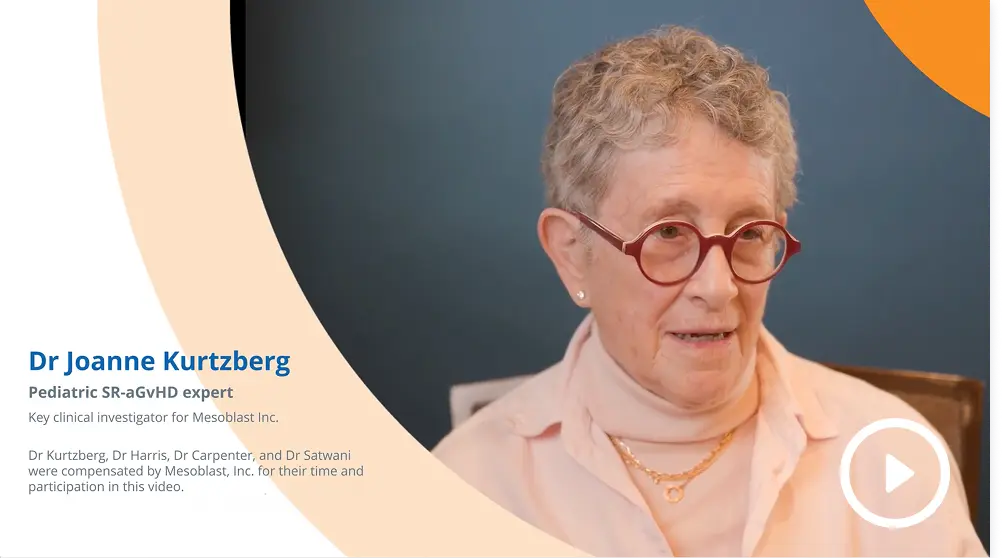

...Only half the children who get steroids respond.
Dr Joanne Kurtzberg
acute GvHD expert


A stem cell transplant can be a fresh start for many families. For some, the days and weeks after can bring questions, especially if health problems come up. Learning about steroid-refractory acute GvHD can help. It can give you the tools to talk with your child's care team. And it can help you feel more ready for what comes next.
After a bone marrow transplant, some children get sick with a condition called acute GvHD. This happens when donor immune cells get confused and attack parts of the child’s body. Acute GvHD may affect the gastrointestinal, or GI, tract (eg, stomach and intestines). It may also affect the liver and/or skin. Acute GvHD most often develops within the first 100 days after a bone marrow or stem cell transplant. However, sometimes it can appear later.
Not every child who has a transplant will get acute GvHD. It can affect 3 to 7 out of every 10 transplant patients.

In a bone marrow transplant, sick blood-forming cells are replaced with healthy cells from a donor.

These new donor cells help the body make healthy blood again.

Sometimes, these new cells get confused. They may think your child's own cells don't belong.

This confusion may cause the new cells to attack parts of your child's body. This can lead to issues in the GI tract, liver, and/or skin.
Donor cells may send attack signals that cause the immune system to go into overdrive.
These attack signals may cause inflammation in the GI tract, liver, and/or skin.

acute GvHD most often shows up in the first 100 days after a bone marrow transplant.
Doctors usually treat acute GvHD with steroids. For many children, steroids help. But for about half, they don’t work well enough. When this happens, it's called steroid-refractory acute GvHD.
...Only half the children who get steroids respond.
Dr Joanne Kurtzberg
acute GvHD expert
You play an important role in your child’s care. That’s because you know your child best. Watching for symptoms can help you stay one step ahead of acute GvHD. If you notice changes, tell the care team right away. Working together can help your child get the support they need.
Steroid-refractory acute GvHD symptoms may affect certain parts of the body, including the GI tract, liver, and/or skin.
Commonly has no symptoms you can see, but may include:
Symptoms of liver failure include:
If steroids failed to control your child's acute GvHD, you may wonder, “What if we need to move beyond steroids? What's our next step?” The good news is you are not out of options. RYONCIL was developed for moments like this, when more help is needed.
RYONCIL is a first-of-its-kind cell therapy. It has been shown to be safe and effective for children.
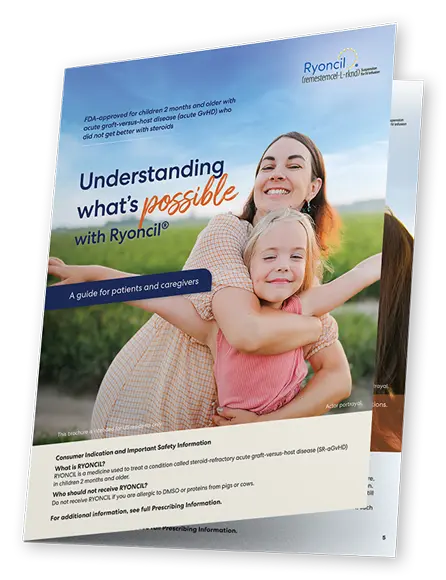
Download “Understanding What's Possible With RYONCIL”

Get support at every step
Learning that your child has steroid-refractory acute GvHD can feel scary. But it’s important to know that you are not alone. Support is available to help your family move forward.
Get support resources
See why recovery is possible with RYONCIL
Learn more about the first and only FDA-approved treatment approved just for children with steroid-refractory acute GvHD.
About RYONCILHave questions? We have answers
Get answers to common questions about steroid-refractory acute GvHD and treatment with RYONCIL.
Explore Q&A
RYONCIL is a prescription medicine used to treat a condition called steroid-refractory acute graft versus host disease (SR-aGvHD) in children 2 months and older.
Do not receive Ryoncil if you are allergic to DMSO or porcine and bovine proteins (e.g., pigs or cows).
Ryoncil is not recommended if you are pregnant. Talk to your doctor about the risks and benefits of breastfeeding during Ryoncil treatment.
The most common side effects include infections, fever, bleeding, swelling, stomach pain, high blood pressure, vomiting, irregular heartbeat, diarrhea, rash, joint pain, low blood pressure, cough, and trouble breathing.
Tell your doctor about all your medical conditions, allergies, and if you are pregnant or breastfeeding.
You are encouraged to report negative side effects of prescription drugs to the FDA. Visit www.fda.gov/medwatch, or call 1–800-FDA-1088.
For additional information, see full Prescribing Information.